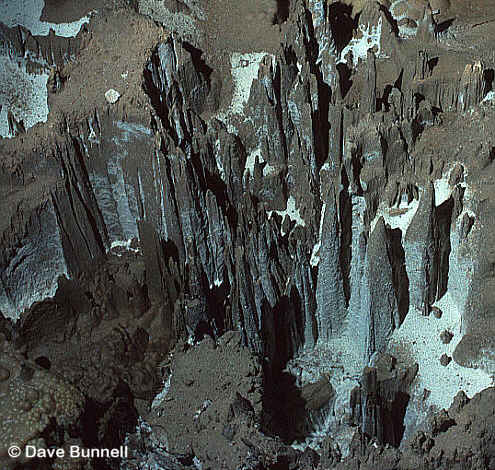
Mud stalagmites are not a depositional form, like standard stalagmites, but instead form by erosion. If water drips onto a mud-covered slope, it may drill holes and leave sharp, pointed edges around them. Most mud stals have very sharp peaks. Similar stals may form in sand or clay, and the former are sometimes called sand castles. Theses types of stal often form where gravel or small pebbles cover the mud, sand, clay, or gypsum. An individual pebble, more resistant to erosion, protects the material beneath and a pillar forms with the cap-rock perched on top. This mechanism is similar to towers on a much larger scale seen in areas of the Colorado Plateau, where they are sometimes called hoodoos.
|

| Back to: | |
 |
Created: December, 1998 Author: Dave Bunnell |